10 Casino Games with the Lowest House Edge

Every casino game gives the operator a mathematical advantage, known as the house edge. The lower the house edge, the higher the game’s theoretical return to player (RTP), although the exact figure can depend on the rules, payout table and, in games such as blackjack and video poker, the decisions you make.
This guide compares ten of the lowest-house-edge casino games and explains the bet, rules or strategy required to achieve each figure.
What is House Edge?
The house edge is the casino’s expected mathematical advantage, expressed as a percentage of the amount wagered. It applies whether you play at a land-based venue or at Canadian online casinos.
If a game has a house edge of 2.7%, the theoretical average loss is $2.70 for every $100 staked over a very large number of bets. It does not mean that every $100 session will result in a $2.70 loss, as short-term results can vary considerably.
House edge and RTP are two sides of the same coin: a game with an RTP of 97.3% has a house edge of 2.7%.
The Lowest House Edge Casino Games at a Glance
The games below are ordered from lowest to highest house edge, based on the versions, bets and strategies stated. Individual variants may produce a higher or lower figure.
| Game | Lowest-Edge Option | House Edge |
|---|---|---|
| Video Poker | All Aces Poker, playing five coins with optimal strategy | 0.08% |
| Blackjack | Single Deck Blackjack paying 3:2, using correct basic strategy | 0.09% |
| Baccarat | Banker bet with 5% commission | 1.06% |
| Roulette | Even-money bet on French Roulette | 1.35% |
| Craps | Don’t Pass; optional Odds pay at true odds | 1.36% on Don’t Pass |
| Casino Hold'em | Ante + Call, using optimal strategy | 2.16% of Ante |
| Ultimate Texas Hold'em | Main game, using optimal raises | 2.19% of Ante |
| Pai Gow Poker | Main bet, using optimal hand setting | 2.51% |
| Sic Bo | Big or Small, with triples losing | 2.78% |
| Three Card Poker | Ante + Play, raising Q-6-4 or better | 3.37% of Ante |
These percentages represent long-term mathematical averages, not what you should expect to win or lose during a single session.
10. Three Card Poker
House Edge: 3.37% of the Ante

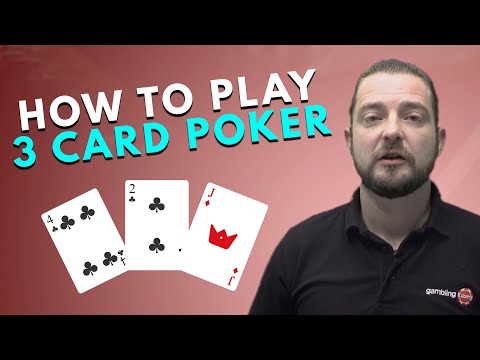
Three Card Poker strips poker down to one main decision: play the hand or fold it. You begin by placing an Ante and receiving three cards, after which you either fold or place a Play bet equal to the Ante.
The dealer then reveals their cards and must have queen-high or better to qualify. If the dealer does not qualify, the Ante pays 1:1 and the Play bet is returned. If they qualify, the higher hand wins.
Under the common Ante Bonus paytable, the house edge is 3.37% of your Ante when you use the correct play-or-fold strategy.
Fortunately, that strategy is much simpler than the poker notation makes it sound. Place the Play bet with any pair or better, any ace-high or king-high hand, or a queen-high hand of queen-six-four (Q-6-4) or better.
Queen-six-four is simply the cut-off point: play Q-7-2, Q-6-5 and Q-6-4, but fold Q-6-3, Q-5-4 and anything lower.
Pair Plus may add more ways to win, but it is a separate wager with its own paytable and house edge.
How to Minimise the House Edge in Three Card Poker
- Follow the queen-six-four rule when deciding whether to play or fold
- Check the Ante Bonus paytable
- Treat Pair Plus and other side bets as separate wagers
9. Sic Bo
House Edge: As Low as 2.78%

Sic Bo presents players with a busy betting layout, but the low-edge choice is surprisingly simple. Three dice are rolled and you can bet on their combined total, individual numbers or specific combinations.
The two lowest-edge standard wagers are Big and Small. Small wins when the dice total 4-10, while Big covers totals of 11-17. Both pay even money but lose if the roll produces any triple, which gives the house its 2.78% edge.
The rest of the betting layout is where the numbers quickly turn against you. Wagers on particular totals, combinations and triples can carry substantially higher house edges.
How to Minimise the House Edge in Sic Bo
- Choose Big or Small
- Avoid bets on specific totals, combinations or triples
8. Pai Gow Poker
House Edge: 2.51%

Pai Gow Poker is less about making one winning hand than arranging two hands correctly. You receive seven cards and divide them into a five-card high hand and a two-card low hand. Your five-card hand must rank higher than your two-card hand.
You win when both hands beat the dealer's corresponding hands. Winning one and losing the other produces a push, while losing both means the wager is lost. A tie in either hand goes to the banker.
Those frequent pushes give Pai Gow Poker a slower rhythm than many casino games, but they do not remove the house advantage. The 2.51% figure assumes theoretically optimal hand setting under traditional rules where the dealer acts as banker and a 5% commission is charged on wins.
Following the casino's "house way" to arrange your cards is easier, but under the same rules it can increase the house edge to around 2.72%. Optional Fortune and bonus wagers also have their own paytables and should not be confused with the main bet.
How to Minimise the House Edge in Pai Gow Poker
- Use a game-specific strategy for arranging both hands
- Check that the five-card hand ranks above the two-card hand to avoid fouling
- Assess the separate house edge before placing Fortune or other bonus wagers
7. Ultimate Texas Hold'em
House Edge: 2.19% of the Ante

Ultimate Texas Hold'em is played against the dealer, with the most important decisions arriving before the community cards have fully revealed the strength of your hand.
You begin by placing equal Ante and Blind bets before receiving two hole cards. You can then place a Play bet at one of three stages: three or four times the Ante before the flop, twice the Ante after the first three community cards or once the Ante after all five community cards have been dealt. At the final stage, the alternative is to fold.
With optimal strategy, the house edge is approximately 2.19% of the initial Ante. Because the Blind and Play bets increase the amount placed during an average hand, the same expected loss is approximately 0.53% when measured against the average total amount wagered.
That lower figure is not a more generous version of the game. It is simply the same expected loss measured against all the money typically placed rather than the Ante alone.
Ultimate Texas Hold'em rewards correct aggression. When your cards are strong enough to raise before the flop, placing the full 4x Play bet produces a better theoretical return than choosing 3x.
How to Minimise the House Edge in Ultimate Texas Hold'em
- Use a strategy chart for each of the three decision stages
- Place the full 4x Play bet when the strategy calls for a pre-flop raise
- Treat the Trips bet and other side wagers separately
6. Casino Hold'em
House Edge: 2.16% of the Ante

Casino Hold'em borrows the shape of Texas Hold'em but removes the bluffing and table politics: your only opponent is the dealer.
You and the dealer each receive two hole cards, followed by three shared community cards. After seeing your cards and the flop, you either fold or place a Call bet worth twice your Ante.
Two further community cards are then dealt and the best five-card poker hand wins. The dealer normally needs a pair of fours or better to qualify.
Under a commonly used Ante paytable, the house edge is approximately 2.16% of the initial Ante when decisions are made using optimal strategy. Unlike the queen-six-four rule in Three Card Poker, there is no equally neat one-line shortcut, so a proper strategy chart is useful.
Jackpot and bonus wagers may add another route to a payout, but they are separate bets with their own paytables and house edges.
How to Minimise the House Edge in Casino Hold'em
- Use a full strategy chart when deciding whether to Call or fold
- Check the Ante paytable before playing
- Treat jackpot and bonus wagers separately from the main game
5. Craps
House Edge: 1.36% on Don't Pass; 0% on Odds

Craps has one of the busiest betting layouts in the casino, but the low-edge route runs through only a small part of it.
The Don't Pass bet has a house edge of 1.36%, while the similar Pass Line bet is close behind at 1.41%. Once a point has been established, you can lay Odds behind Don't Pass or take Odds behind Pass Line.
The Odds wager pays at the true mathematical odds, so the additional bet has no house edge. It does not, however, erase the expected loss attached to the original line bet. Instead, it reduces the effective house edge as a percentage of the larger combined amount wagered.
That makes Odds mathematically attractive, but not free money. You are still placing a larger total stake, so taking more Odds can increase the amount won or lost on an individual result.
Most of the colourful proposition and single-roll bets in the centre of the layout carry much higher house edges, as our craps odds guide explains.

How to Minimise the House Edge in Craps
- Use Don't Pass and lay Odds once a point is established
- Consider Pass Line with Odds as a close alternative
- Avoid high-edge proposition and single-roll wagers
- Do not increase your planned stake solely to take more Odds
4. Roulette
House Edge: As Low as 1.35%

Roulette makes the casino’s advantage easy to see: it sits in the zero pocket, although French roulette can soften its effect.
French roulette offers the lowest standard roulette house edge when the table applies the la partage rule. Like European roulette, it uses a single-zero wheel with 37 pockets, numbered 1-36 plus zero.
Under la partage, half of an even-money stake is returned when the ball lands on zero. This reduces the house edge to 1.35% on red or black, odd or even and high or low bets.
Some French online roulette tables use the en prison rule instead. When zero lands, the entire even-money stake is held for the next spin. If the bet wins on that spin, the original stake is returned without profit; if it loses, the stake is lost. This also reduces the theoretical house edge to 1.35%.
Standard European roulette uses the same single-zero wheel but does not usually apply either rule, giving it a house edge of 2.70%. French roulette tables can be harder to find, but the difference is worth checking before you play.
American roulette adds a double zero without increasing the payouts, raising the house edge on most bets to 5.26%.
How to Minimise the House Edge in Roulette
- Choose a single-zero table offering la partage or en prison
- Place an even-money bet to benefit from those rules
- If the French variant isn't available, choose single-zero European rather than double-zero American roulette
3. Baccarat
House Edge: As Low as 1.06%

Baccarat may look formal, but the best low-edge decision is made before the cards are dealt: choose the Banker bet.
Standard baccarat offers three main wagers: Banker, Player and Tie. Two hands are dealt according to fixed drawing rules, with the hand finishing closest to nine winning. You bet on the result rather than deciding whether either hand should receive another card.
The Banker bet has a house edge of 1.06%, assuming the usual 5% commission is deducted from winning bets. Player is close behind at 1.24%, while Tie has a much higher edge of approximately 14.36% when it pays 8:1.
The commission is already included in the 1.06% calculation, so Banker remains the lowest-edge standard wager despite paying slightly less than even money. The larger Tie payout may look tempting, but that is precisely where the casino's advantage increases sharply.
Commission-free baccarat variants can alter the payout on particular Banker wins, so do not assume they share the same 1.06% edge without checking the rules.
You can see how the fixed drawing rules work by playing baccarat for free.
How to Minimise the House Edge in Baccarat
- Choose the Banker bet at tables charging the standard 5% commission
- Avoid the Tie bet and higher-edge side wagers
- Check the modified payouts used by commission-free variants
2. Blackjack
House Edge: As Low as 0.09%

Blackjack is often quoted as having a house edge of around 0.5%, but the exact figure depends on the game’s rules and some individual versions go lower.
For example, Aristocrat Interactive’s Single Deck Blackjack and Microgaming’s Classic Blackjack Gold Series both have a published RTP of 99.91% when played using correct basic strategy, leaving a house edge of just 0.09%.
However, this high return does not apply to every single-deck game.
When comparing games at blackjack sites, first check the payout for a natural blackjack: paying 6:5 rather than 3:2 adds about 1.4 percentage points to the house edge.
Other favourable rules include the dealer standing on soft 17 and the option to double after splitting. The number of decks also affects the edge, but the blackjack payout and playing rules matter more than simply choosing tables with the fewest decks.
Basic strategy tells you when to hit, stand, double or split based on your cards and the dealer's face-up card. It will sometimes recommend a move that feels uncomfortable, which is precisely why relying on instinct tends to cost more.
The correct decisions vary slightly between rulesets, so use a chart designed for the particular game you are playing. Our blackjack strategy guide explains these decisions in more detail.
Insurance and optional side bets should be treated separately. They may make a hand more eventful, but they generally carry a substantially higher house edge than the main game.

How to Minimise the House Edge in Blackjack
- Choose games paying 3:2 for a natural blackjack
- Use the correct basic strategy for the table rules
- Prefer games where the dealer stands on soft 17
- Avoid insurance and optional side bets
1. Video Poker
House Edge: As Low as 0.08%

Video poker just takes the top spot in this ranking, but its exact house edge depends on the variant, paytable and strategy, and may also vary with the number of coins played.
Most versions are based on five-card draw. After receiving five cards, you choose which to hold and replace the rest. Any winning hand is paid according to the displayed paytable.
All Aces Poker from Microgaming has a published RTP of 99.92% when five coins are played, equivalent to a house edge of just 0.08%. With one to four coins, its RTP falls to 98.68%, increasing the house edge to 1.32%.
That does not mean you should increase your overall spend to play five coins. Choose a lower coin value that keeps the five-coin total within your existing limit.
Achieving the stated RTP also depends on using optimal strategy. Some hold decisions are obvious, but others involve choosing between competing draws, so guessing your way through the game will not produce the advertised return.
Full-pay 9/6 Jacks or Better is another low-edge option, offering an RTP of 99.54% with optimal strategy. The “9/6” refers to payouts of 9:1 for a full house and 6:1 for a flush.
You can practise comparing paytables and making hold decisions by playing free video poker.
How to Minimise the House Edge in Video Poker
- Compare the RTP and paytable of each variant
- Use the correct strategy chart for the exact game and paytable
- Check whether the RTP changes with the number of coins and keep the total stake within your limit
Why Slots Are Not in the Top 10
Slots are not included in our top 10 because there is no single house edge that applies to the category. Each individual title has its own RTP, and some software providers release the same game with several RTP settings.
As a result, the same slot may offer a different theoretical return at different Canadian slot sites.
Unlike blackjack or video poker, players cannot reduce a slot’s built-in house edge through strategy. The useful decision therefore comes before the reels start spinning: check the game information and published RTP rather than assuming that a familiar title offers the same return everywhere.
Casino Games and Bets with a High House Edge
At the other end of the scale are games and individual bets where the house takes a much bigger cut. They can still produce a win on any given round, but a higher house edge means a larger theoretical average loss for every $100 staked over time.
| Game or Bet | House Edge |
|---|---|
| Keno | Varies by paytable; often around 20%-25% |
| Craps - Any Seven at 4:1 | 16.67% |
| Sic Bo - Specific Triple at 180:1 | 16.20% |
| Baccarat - Tie at 8:1 | 14.36% |
| American Roulette | 5.26% |
Keno has a high house edge built into the game, although the exact figure depends on the paytable. More often, the expensive choices are optional bets sitting alongside much better-value core wagers.
Baccarat is the clearest example: the Banker bet has a house edge of just 1.06%, but that rises to 14.36% for a Tie paying 8:1.
Craps and Sic Bo follow the same pattern, with some wagers carrying an edge many times higher than the lowest-edge bets featured in our top 10.
A large advertised payout is not automatically good value. It reflects an unlikely result, and the payout may still fall well short of the true odds.
Final Thoughts on Keeping the House Edge Down
You cannot eliminate the casino’s overall advantage, but you can avoid making it larger. The lowest figures in this guide depend on choosing the right rules, paytable or wager and, in games involving player decisions, using the correct strategy consistently.
To keep the house edge as low as possible:
- Compare the rules, published RTP and paytable before playing
- Look for full-pay versions and the lowest-edge core wagers
- Use the correct strategy for blackjack, video poker and casino poker games
- Treat side bets as separate wagers and check their house edge
Not every casino offers the most favourable version, and two games with the same name may have different rules, paytables or RTPs. Check these details rather than assuming the headline figure applies everywhere.
A lower house edge reduces the casino’s mathematical advantage over time, but it does not guarantee a winning session.
Your stakes, playing speed and time spent playing also affect how much money you expose to that edge. Smaller stakes and shorter sessions do not change the percentage, but they can reduce the overall cost of play, so set your limits before you begin and stick to them.
FAQs
Which casino game has the lowest house edge?

In our research the lowest house edge for any casino game is All Aces Poker, which has a house edge of just 0.08% playing five coins with optimal strategy. Favourable blackjack games can be as low as 0.09% with correct basic strategy, though around 0.5% is more typical.
Does a lower house edge mean I am more likely to win?
A lower house edge means the casino’s theoretical average advantage is smaller over many bets. It does not guarantee that you will win a particular hand, spin or session, as short-term results can vary considerably.
Can the same casino game have different house edges?
Yes. The house edge can change according to the rules, paytable, wager and strategy used. For example, single-zero roulette has a lower edge than double-zero roulette, while a blackjack paying 3:2 is more favourable than one paying 6:5.
Which casino game is the fairest?
Games at licensed casinos must meet technical fairness standards: RNG games are independently tested, while live dealer games use controlled physical equipment and dealing procedures. In terms of the lowest house edge, video poker and blackjack are the best options, providing the correct strategy is used in each.
Do casino bonuses reduce the house edge?
No. Bonuses do not change the underlying maths of a game. They may provide additional value, but this depends on the wagering requirement, eligible games, game contribution, maximum bet and other conditions attached to the offer.
Does betting more reduce the house edge?
Usually not. Increasing your stake generally increases the expected monetary loss without changing the percentage edge. Some paytables or combined wagers offer a better effective return at particular stake levels, but you should not exceed your planned limit to access them.
Can strategy eliminate the house edge?
Strategy can reduce the house edge to its theoretical minimum in games such as blackjack, video poker and casino poker variants, but it does not normally remove it completely. Incorrect decisions increase the edge above the figures shown in this guide.