World Cup Hydration Breaks: Ad Inventory Opportunities That Didn’t Exist in 2022

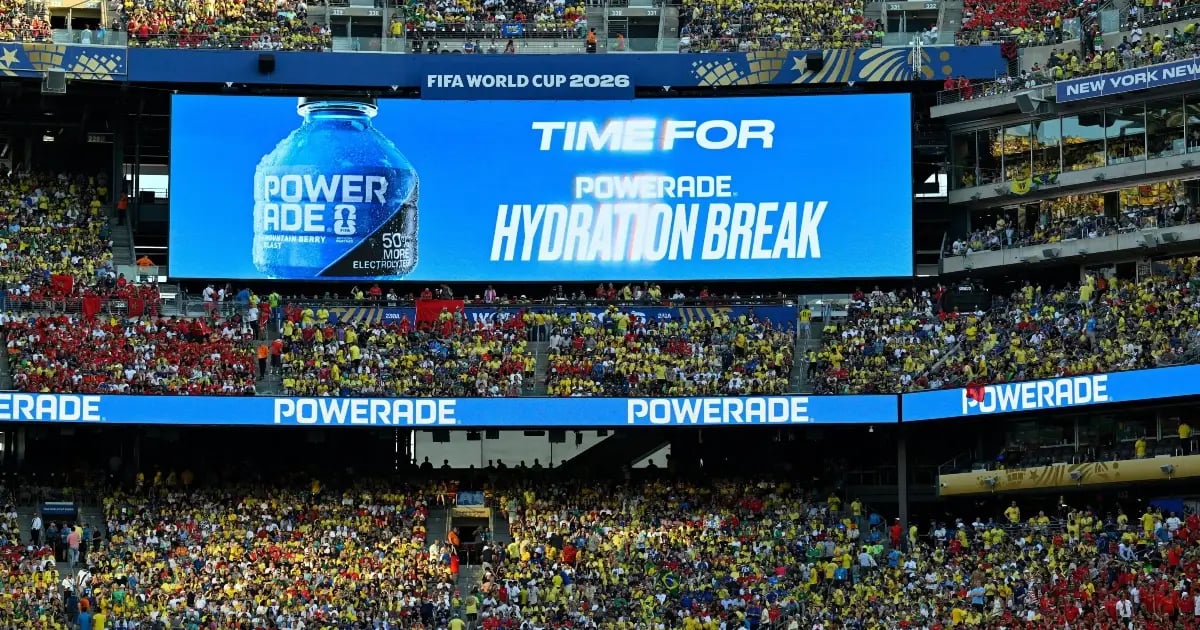
The 2026 FIFA World Cup is less than a week old and Fox has already overrun its first advert break - and FIFA chose not to penalise them.
FIFA’s decision to introduce mandatory hydration breaks at every match of the 2026 World Cup was announced as a player welfare measure and already it is looking like something else entirely.
Fox Sports, which is paying a reported $485 million for its World Cup broadcast rights, stands to generate between $249.6 million and $332.8 million from hydration break advertising alone, potentially covering more than half its rights fee from a category of inventory that did not exist at the last World Cup.
The math is straightforward. FIFA’s rules allow a 20-second buffer before commercials can start and require networks to return to the match feed at least 30 seconds before play resumes.
That leaves roughly two minutes and 10 seconds of usable inventory per break or as many as 832 commercial slots across the tournament’s 104 matches.
At a conservative average of $300,000 per 30-second spot that yields $249.6 million. At $400,000 per spot, Fox’s total climbed to $332.8 million.
The Rule
FIFA announced the hydration break policy in December 2025, positioning it as a player safety measure. Broadcasters were granted permission to sell ads during the breaks in March 2026, roughly three months later.
The breaks are scheduled at fixed times regardless of weather, effectively splitting matches into quarters. The previous temperature threshold of 32°C, above which breaks could previously be triggered, has been abolished.
Breaks now occur in every match including those inside the fully air-conditioned, roofed stadiums in Dallas, Houston and Atlanta, where the heat rationale does not apply.
What’s Already Happening On The Ground
The commercial logic was visible from the first kick.
During the tournament opener between Mexico and South Africa, Fox ran full-screen commercials during the hydration pauses and overran its slot by 40 seconds, meaning viewers missed live match action when play resumed.
FIFA opted not to penalise Fox for the breach. The contrast with Telemundo is stark.
Telemundo’s Senior Vice President of Sports Content Miguel Lorenzo told Sports Business Journal the network’s goal was to provide an uninterrupted viewing experience, staying on the match feed for replays and analysis during hydration breaks.
Telemundo’s announcers told viewers directly: “The World Cup is ours, we are not going to take a break from it.”
The two US broadcasters holding rights to the same tournament have made opposite calls on the same inventory. One is banking hundreds of millions.
The other is banking goodwill. Adweek noted that Fox did not even tout the hydration break inventory during its upfronts, and that buyers were largely unaccustomed to budgeting for it suggesting the revenue opportunity crystallised relatively late, and quickly.
Build your daily yard of horses in our new 'Stables Stars' fantasy game below to be in with a chance of winning £100, £50 or £25.
Play Stable Stars Here
The Heat Data
The welfare case is not without foundation. Gambling.com’s analysis of published climate and sports science data shows that one in four matches is projected to be played at 26°C or above, a level at which heat stress begins to meaningfully affect athletic performance.
The highest-risk outdoor venues include Miami, Philadelphia, Kansas City, Boston, and New York. Up to 14 of the 16 host stadiums could breach the 28°C threshold in a hotter-than-average summer.
The 2025 Club World Cup also exposed the limits of the previous approach, with players showing signs of heat stress even under previously approved conditions.
But the rule’s blanket application to climate-controlled indoor venues and FIFA’s decision not to penalise Fox for overrunning its first break raises a question the welfare framing cannot easily answer.
If player safety were the sole driver, why does the rule apply uniformly in air-conditioned stadiums, and why was the commercial breach met with silence?
The Bigger Picture
FIFA confirmed the 2026 broadcast partnerships set record-breaking media rights revenues across over 220 territories worldwide.
"The 2026 World Cup is the largest in history, with 48 teams, 104 matches, and a record-breaking broadcast rights deal across 220 territories. The hydration break didn’t just solve a heat problem it solved an ad inventory problem that American broadcasters have always had with soccer." - Dean Ryan, Betting Expert at Gambling.com
The projected $3.92 billion in broadcast rights revenue makes it the highest-grossing broadcast deal in the history of any single sporting event.
The hydration break and the 832 commercial slots it creates sits inside that context.