CFTC Proposes New Crypto Trading Rules: What It Means for Prediction Markets


The Commodity Futures Trading Commission (CFTC) on Oct. 5, 2026, published an Advance Notice of Proposed Rulemaking proposing its first dedicated rules for crypto asset trading, called Regulation Crypto Asset Transactions (Regulation CTX) and Regulation Crypto Asset Markets (Regulation CAM).
The agency is the same federal regulator that already oversees prediction market platforms such as Kalshi and Polymarket, and it published its own ANPRM on prediction markets earlier this year using an almost identical process.
CFTC Chairman Michael S. Selig announced the proposal in remarks prepared for Fordham Law's Blockchain Regulatory Symposium and in a Wall Street Journal op-ed.
Neither document names prediction markets directly, but the rulemaking lands on the same legal foundation, the Commodity Exchange Act, and under the same chairman who has made oversight of both crypto and event-contract trading a signature issue in his first year running the agency.
What the CFTC Actually Proposed
The CFTC's advance notice does not create binding rules on its own. It opens a public comment window and signals where the agency intends to go.
According to the agency's press release, Regulation CTX and Regulation CAM would:
- Create a new, purpose-built category of CFTC-registered exchange, called a "crypto asset market," for trading crypto assets such as bitcoin and ether.
- Let those registered platforms offer retail customers margined, leveraged, or financed crypto trading, something state-licensed exchanges cannot do.
- Set crypto-specific standards for preventing abusive and manipulative trading practices.
- Remain voluntary: Exchanges are not required to register under the new framework, since the CFTC says it lacks the authority to mandate that without new legislation from Congress.
Comments are due within 60 days of the ANPRM's publication in the Federal Register, after which the Commission will decide whether, and how, to move to a formal rulemaking.
Selig: 'We're Creating a Federal Option'
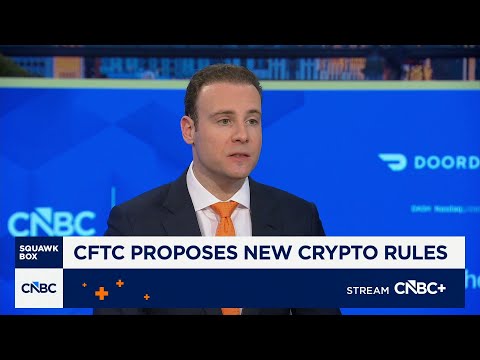
Selig expanded on the proposal the next morning in a CNBC interview, describing it as a "federal option" rather than a mandate.
"We don't have the ability to say every exchange needs to register with us, as the Clarity Act would've done, but we can create a federal option, and that's exactly what we're doing here today," he said.
He compared it to state versus federal bank charters: platforms that register under the new framework would be able to offer margin, leverage or financing on crypto trades, activity state-licensed money transmitters cannot provide.
"These are all licensed as money transmitters, so it's more of a payment platform," he said of the state-level alternative. "They can't engage in market-based exchange activities."
Asked how much leverage the CFTC would allow compared with offshore crypto exchanges offering 50x or 100x leverage, Selig said US-regulated platforms would remain well below that.
"We've not allowed for that to happen at all," he said, noting that CFTC-regulated perpetual contracts already carry less leverage than traditional futures.
He also said the agency is "building out a very comprehensive on-chain surveillance system" for platforms offering derivatives directly on-chain, working alongside the SEC under an existing memorandum of understanding on cross-agency surveillance.
Why This Touches Prediction Markets
The timing matters for anyone who trades on prediction markets.
In March 2026, the CFTC used the same tool, an ANPRM, to ask the public how existing rules should apply to event contracts traded on platforms it calls prediction markets. Chairman Selig said at the time that the goal was "reassuring the American people that the CFTC will exercise its exclusive jurisdiction over prediction markets," pushing back on state regulators that have tried to block platforms like Kalshi from offering sports-related event contracts.
In the same CNBC interview, Selig was asked about prediction markets after a CNBC anchor cited Wall Street Journal reporting that young quants and computer scientists are flocking to prediction markets to exploit pricing inefficiencies, similar to those in early crypto markets. Selig did not dispute that read.
"With any new market, you're going to see this sort of behavior," he said, comparing it to the early stock market and the early days of crypto. "The markets become more efficient over time ... we expect with markets, just as we're doing with crypto, just as we've done with prediction markets."
He added that several recent CFTC enforcement actions have targeted manipulative trading and insider trading on prediction market platforms, and warned that unregulated, state-level alternatives pose a bigger risk than quant trading itself.
"My concern is that you've got these unregulated markets in various places, or the states think that these products can trade in a casino," he said, referring to legal fights in which states have argued event contracts should fall under tribal compacts or state casino regulation rather than CFTC oversight. "That's exactly where you're gonna find an order book with absolutely no market-based controls in place, and that's gonna be a real harm to the American people."
Today's crypto ANPRM does not fold prediction markets into Regulation CTX or Regulation CAM. But several of the largest prediction market platforms route trades through crypto rails.
Polymarket settles its event contracts in the stablecoin USDC, and the ANPRM's new "crypto asset market" registration category is explicitly built for exchanges offering leveraged or margined trading in crypto assets. If a prediction market operator wanted to add crypto-denominated, margined products alongside its event contracts, this is the framework it would eventually register under.
The two rulemakings are traveling on parallel tracks, both aimed at bringing fast-growing, previously grey-area markets under one federal roof instead of a patchwork of state rules.
Selig's Case: 'Written by Crisis' vs. 'Written by Opportunity'
In a Wall Street Journal op-ed, Selig framed the new crypto proposal as a direct response to the collapse of FTX, the offshore crypto exchange whose founders misappropriated roughly $8 billion in customer funds before it failed in 2022. He argued that the prior approach of "regulation by enforcement" pushed crypto firms offshore or into state money-transmitter licenses that were not built for financial markets, while FTX's CFTC-registered US subsidiary kept customer funds segregated and intact through the bankruptcy.
"The last chapter of crypto regulation was written by crisis. The new frontier of finance will be written by opportunity, innovation and clear rules. - Chairman Michael S. Selig"
The proposal follows a joint CFTC-SEC interpretation issued earlier in 2026 that found a swath of crypto assets, including bitcoin and ether, are not securities and fall under the CFTC's jurisdiction rather than the SEC's. It also comes weeks after the Senate failed to advance the Clarity Act, the bill that would have given Congress, rather than the agencies, the final say on crypto market structure.
What Happens Next
Nothing changes immediately for traders on Kalshi, Polymarket, or crypto exchanges. Both the crypto ANPRM and the prediction markets ANPRM are still at the comment-gathering stage, and the CFTC has not set a date for a formal rule proposal on either track.
The agency has said it will use the responses it receives to shape any future rulemaking.
For now, the clearest signal is direction of travel: a single CFTC leadership team is simultaneously building a federal framework for crypto trading and defending its exclusive jurisdiction over prediction markets, two product categories that increasingly overlap for the exchanges and traders moving between them.
Related Stories





FAQs
What did the CFTC propose on Oct. 5, 2026?

An Advance Notice of Proposed Rulemaking covering Regulation Crypto Asset Transactions (Regulation CTX) and Regulation Crypto Asset Markets (Regulation CAM), which would create a voluntary, CFTC-registered category of exchange for margined, leveraged, or financed crypto asset trading.
Does the new crypto rule apply to Kalshi or Polymarket?
Not directly. The Oct. 5 ANPRM covers crypto asset trading generally, while the CFTC is separately reviewing prediction markets under an ANPRM it published in March 2026. The two efforts share the same legal basis and the same chairman, and could eventually intersect for platforms that offer both event contracts and crypto-denominated trading.
When are public comments due?
Comments on the crypto ANPRM are due within 60 days of its publication in the Federal Register.
Did Selig address quant trading on prediction markets?
Yes. In a CNBC interview the day after the ANPRM, Selig said new markets like prediction markets naturally attract traders who exploit early pricing inefficiencies, comparing it to the early stock market and early crypto trading, and said the CFTC has already brought enforcement actions over manipulative and insider trading on prediction market platforms.

Refer to Cashback Terms & Conditions for full program terms.