Roulette Odds and Strategy

Roulette is among the most popular games at online casinos and land-based venues in the US, with bets ranging from individual numbers to larger groups such as red or black.
In this roulette strategy guide, I explain roulette odds and payouts, compare the main versions, and examine popular betting strategies and staking systems.
How Roulette Works
In roulette, a ball spins around a numbered wheel before settling in a pocket. You bet on where it will land, choosing an individual number, a group of numbers, or a category such as red or black.
The numbers 1-36 are split equally between red and black. The green zero and double zero, where present, are separate outcomes.
You can place several bets on the same spin. Each adds to your total stake, so a payout on one bet does not necessarily mean you have made an overall profit.
Roulette Versions and House Edge
Roulette strategy starts with choosing the most favorable versions; your choice affects the casino's advantage, known as the house edge.
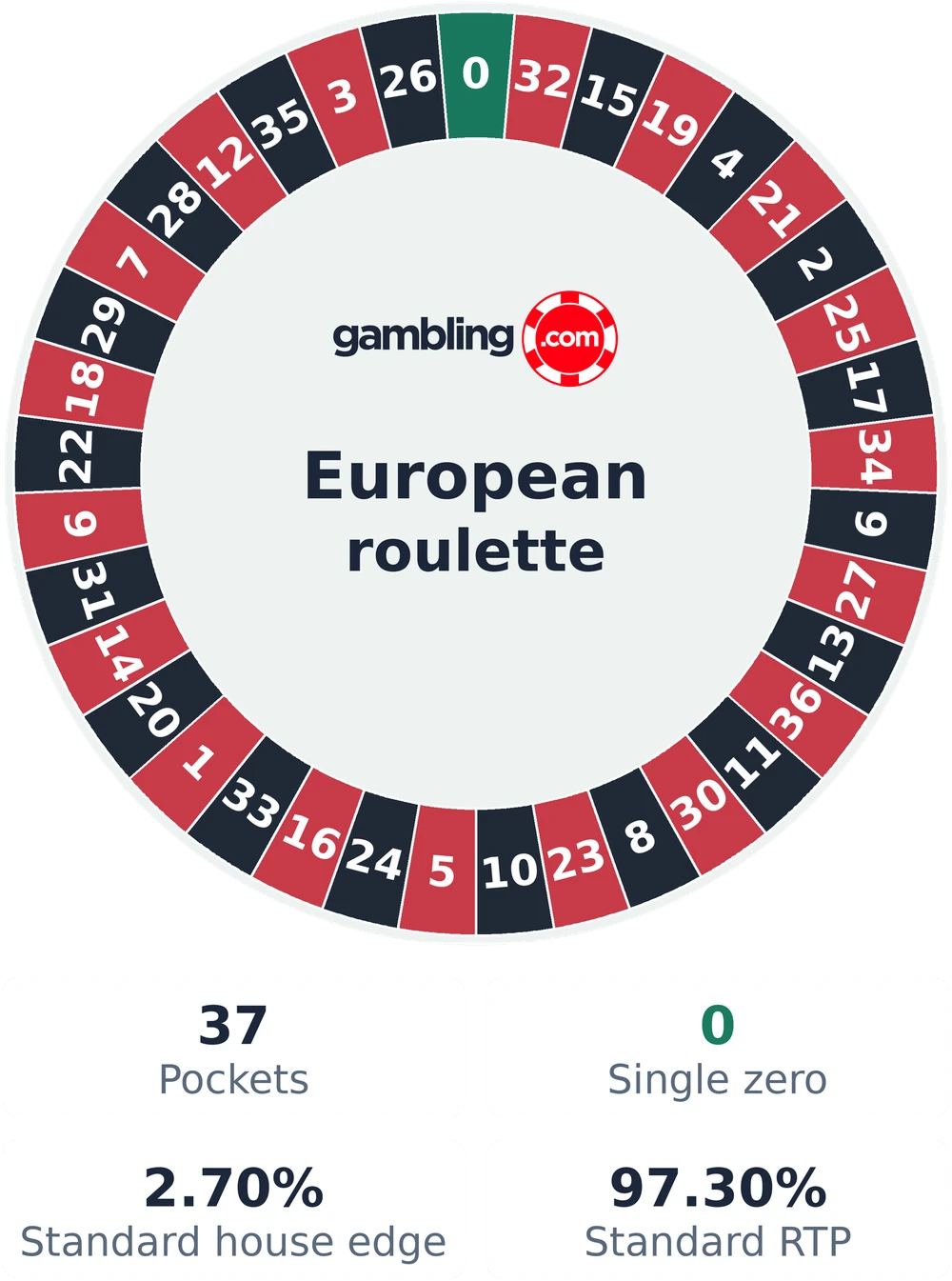
With a 2.70% house edge, the casino expects to keep $2.70 of every $100 staked over time and return $97.30 to players. That is a 97.30% return to player (RTP). Your results in an individual session can vary widely.
European vs American Roulette
There are two main types of roulette wheels: European and American.
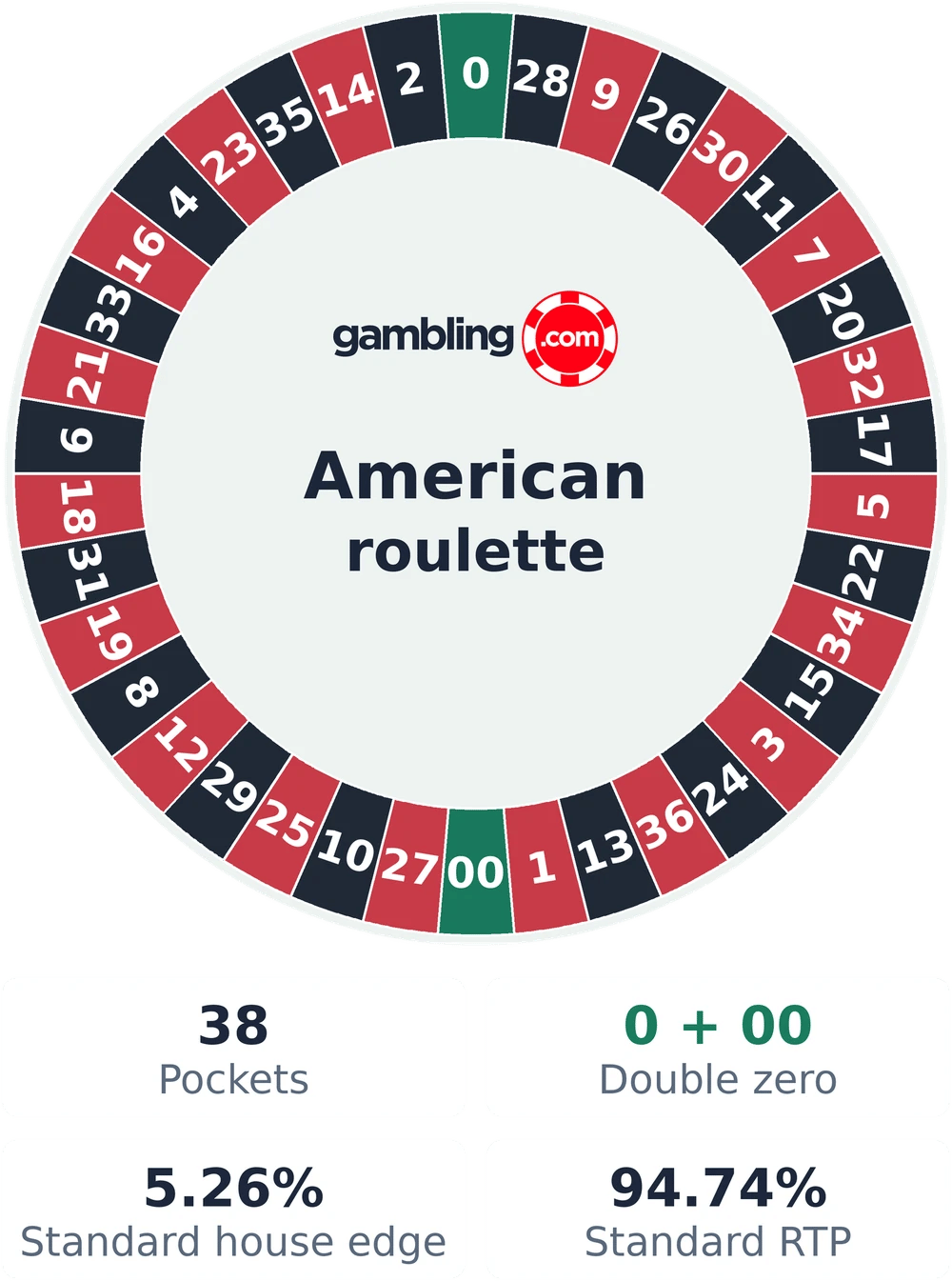
European roulette has 37 pockets: numbers 1-36 and a single zero. American roulette adds a double zero, bringing the total to 38.
All corresponding bets pay the same in both games, but the extra zero reduces your chances of winning and almost doubles the house edge.
The edge comes from the difference between the true odds of winning and the payout.
For example, a straight-up bet on a single number in most roulette games pays 35:1. A winning $1 bet therefore returns $35 in winnings plus your $1 stake ($36 in total).
That number has a one-in-37 chance of appearing on a European wheel and a one-in-38 chance on an American wheel. Payouts matching those chances would be 36:1 and 37:1, respectively.
The lower 35:1 payout creates the casino's advantage in both games. With standard payouts, European roulette offers better value than American roulette.
French Roulette
French roulette uses the same single-zero wheel as European roulette, but offers an additional rule called La Partage ("The Split"), which returns half your stake on even-money bets when zero lands.
This makes it even better value for 1:1 bets on red/black, odd/even, or low/high. For example, a $10 bet on red returns $5 if zero lands. Under standard European roulette rules, the full $10 would be lost.
La Partage reduces the house edge on these bets from 2.70% to 1.35%.
Some land-based casinos give you a choice when zero lands on an even-money bet: take half your stake back under La Partage or leave your full stake on the table for the next spin under En Prison ("In Prison").
If you choose En Prison and the next result matches your original bet, your stake is returned without any winnings. If the opposite result lands, you lose the stake.
Roulette Games with Multipliers
Some roulette games add the chance of much bigger payouts through multipliers and bonus features.
In Evolution's Lightning Roulette at Golden Nugget, between one and five randomly selected numbers are "struck by lightning" each round. If the ball lands on one you've backed with a straight-up bet, you receive a total return of 50 to 500 times your stake.
The trade-off is a lower payout on straight-up wins without a multiplier: 29:1 rather than the standard 35:1. Other bets, including splits, corners, and red/black, retain their standard payouts.
Check the game's help screen for the full paytable and RTP.


Roulette Bets, Odds and Payouts
Roulette bets fall into two broad groups: inside and outside bets.
Inside bets cover individual numbers or small groups on the main grid. A straight-up bet covers one number, a split covers two adjacent numbers, a street covers one row, a corner covers four numbers meeting at an intersection, and a double street covers two adjacent rows.
The European first-four bet covers 0, 1, 2 and 3. The American five-number top-line bet covers 0, 00, 1, 2 and 3.
Outside bets cover larger groups using the boxes around the grid. These include the three columns, the three dozens (1-12, 13-24 and 25-36) and the even-money bets: red/black, odd/even and low (1-18)/high (19-36).

Odds and Payout Tables
The roulette table odds below are based on the 37 pockets of a European wheel, except for the American top-line bet, which uses a 38-pocket wheel. Figures are rounded to two decimal places where needed.
| Inside Bets | Odds | Payout* |
|---|---|---|
| Straight-up | 36:1 | 35:1 |
| Split | 17.5:1 | 17:1 |
| Street | 11.33:1 | 11:1 |
| Corner | 8.25:1 | 8:1 |
| Double street | 5.17:1 | 5:1 |
| First four (European) | 8.25:1 | 8:1 |
| Top line (American) | 6.6:1 | 6:1 |
| Outside Bets | Odds | Payout* |
|---|---|---|
| Dozen or column | 2.08:1 | 2:1 |
| Even-money bets | 1.06:1 | 1:1 |
* Payouts show profit. Your original stake is also returned on a winning bet.
Under standard rules, all the European bets have a 2.70% house edge. The American bets all have a 5.26% house edge, except for the five-number top-line bet at 7.89%.
Roulette Racetrack and Wheel Sections
The racetrack is an oval betting panel showing the numbers in their order around the wheel. Online, it lets you select a named combination of bets, with the game placing the individual bets for you.
These sector bets cover sections of the single-zero wheel used in European and French roulette. They are also known as announced bets, because you can ask a dealer to place them at a land-based casino.

Each sector bet uses a fixed combination of inside bets, such as straight-ups, splits, and corners. A single chip can cover several numbers, and some bets in the combination use two chips:
| Bet | What It Covers | Chips Required |
|---|---|---|
| Jeu Zéro | 7 numbers in a smaller section around zero | 4 |
| Orphelins | 8 numbers in two separate sections | 5 |
| Tiers du Cylindre | 12 numbers opposite zero | 6 |
| Voisins du Zéro | 17 numbers around zero | 9 |
The total cost depends on the chip value you select. For example, with a $1 chip selected, Jeu Zéro costs $4 in total.
Your return can vary depending on which covered number lands.

One chip straight up on 26 and one on each of the 0/3, 12/15 and 32/35 splits.

One chip straight up on 1 and one on each of the 6/9, 14/17, 17/20 and 31/34 splits.

One chip on each of the 5/8, 10/11, 13/16, 23/24, 27/30 and 33/36 splits.

Two chips on the 0-2-3 trio, one on each of the 4/7, 12/15, 18/21, 19/22 and 32/35 splits and two on the 25/26/28/29 corner.
Neighbor Bets
The racetrack also lets you place neighbor bets. These cover your chosen number and the numbers beside it on the wheel.
A common option includes two neighbors on each side, covering five numbers in total. For example, selecting zero on a single-zero racetrack with this setting covers 3, 26, 0, 32, and 15 on the wheel.
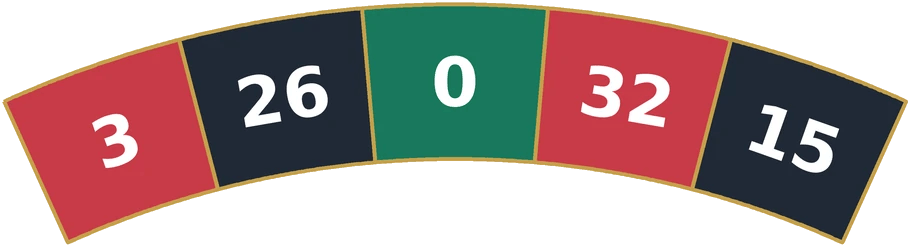
Select a number on the racetrack and the game places one chip on each number as a separate straight-up bet.
With $1 on each number, your total stake is $5. If any of them wins at the standard 35:1 payout, you receive $36, including the winning stake. After deducting your $5 total stake, your profit is $31. Any other result loses the full $5.
Covering more numbers increases the chance that one of your bets wins, but does not improve the expected return per $1 staked. On a single-zero wheel with standard payouts, sector and neighbor bets retain the usual 2.70% house edge.
American roulette games also offer neighbor bets via a racetrack, but their double-zero wheel uses a different number order.
Roulette Betting Strategies
These roulette betting strategies combine bets on the same spin. They change how many numbers you cover and how much you can win or lose, but they do not remove the house edge.
The examples use French roulette, in which half your stake is returned on even-money bets when zero lands. This offers better value for the 3/2 and James Bond strategies, but does not affect the two-dozen or two-column approach.
Two Dozens or Two Columns
Backing two dozens or two columns with equal stakes covers 24 of the wheel's 37 numbers, with the same profit whichever covered number lands. It is a straightforward way to increase your chance of a winning spin compared with backing just one dozen or column.
For example, place $1 on 1-12 and $1 on 13-24. Your total stake is $2. A number from 1 to 24 returns $3, resulting in $1 in profit overall. Zero or any number from 25 to 36 loses the full $2.

The same approach works with equal stakes on any two columns. Whichever pair of dozens or columns you choose, the chances and payouts are the same.
The compromise is clear: you have more winning outcomes than losing ones, but each loss is twice the size of each profit.
Dozen and column bets do not benefit from La Partage, so the overall house edge for this combination remains 2.70%.
The 3/2 Strategy
The 3/2 strategy combines an even-money bet with a column bet, giving some numbers the chance to win both bets on the same spin.
In this example, place $3 on red and $2 on the first column, which contains 1, 4, 7, and so on up to 34. The total stake is $5.

The 3:2 split is deliberate: either bet returns $6 when it wins, enough on its own to cover your full $5 stake and leave $1 profit.
| Result | Overall Profit or Loss |
|---|---|
| Red and the first column both win | $7 profit |
| Only one of the two bets wins | $1 profit |
| A black number outside the first column lands | $5 loss |
| Zero lands | $3.50 loss |
When zero lands, La Partage returns $1.50 from your $3 red bet. The $2 column bet loses, leaving an overall loss of $3.50.
In French roulette, the $3 bet on red has a 1.35% house edge, while the $2 column bet retains the standard 2.70%. Taking both stakes into account, the overall house edge for this combination is 1.89%.
The first column contains six red numbers, and these win both bets. This example therefore covers 24 different numbers, just like the two-dozen approach, but some winning results pay more than others.
Changing the color or column can change how many numbers win both bets and how many remain uncovered.
The James Bond Strategy
Named after the fictional spy known for his visits to casinos, the James Bond strategy includes zero along with a larger set of numbers.
With a $20 total stake, place $14 on high (19-36), $5 on the 13-18 double street, and $1 straight up on zero. Keep those proportions if using a different total stake.

Together, these bets cover zero and every number from 13 to 36.
| Winning Number | Overall Profit or Loss |
|---|---|
| 19-36 | $8 profit |
| 13-18 | $10 profit |
| 0 | $23 profit |
| 1-12 | $20 loss |
If a number from 19 to 36 lands, the $14 high bet wins at 1:1, returning $28 including the winning stake. The other two bets lose, leaving $8 profit from your $20 total stake.
If a number from 13 to 18 lands, the $5 double-street bet returns $30, including your stake. After deducting the full $20 staked across all three bets, your profit is $10.
When zero lands, the straight-up bet returns $36, and La Partage returns $7 from your $14 high bet. You receive $43 in total, leaving $23 profit after deducting the $20 stake.
This combination covers 25 of the wheel's 37 numbers, giving a slightly higher chance of a profitable spin than the two examples above, though any number from 1 to 12 will lose the full $20 stake.
In French roulette, the $14 bet on high has a 1.35% house edge, while the $5 double-street bet and $1 bet on zero retain the standard 2.70%. Taking all three stakes into account, the overall house edge for this combination is 1.76%.
What Is the Best Roulette Strategy?
For long-term value, I recommend even-money bets in French roulette. Red/black, odd/even, and low/high all have a 1.35% house edge thanks to the La Partage rule.
Two dozens or two columns use equal stakes and give the same overall profit when either bet wins. The 3/2 strategy combines overlapping bets, producing a larger profit when both win. James Bond uses different stake amounts across three bets, including a separate bet on zero.
These combinations cover more numbers than a single even-money bet, giving you a higher chance of making a profit on a single spin. However, they also include bets that do not benefit from La Partage, increasing the overall house edge.
James Bond offers the lowest house edge of the three combinations at 1.76%, but this still means a higher expected loss per $1 staked than even-money bets alone.
For a comparison of casinos offering classic online games and live dealer tables, see our guide to the best roulette sites.
Roulette Strategy Myths
Some common beliefs about roulette can lead you to overestimate your chances of winning. Here are four myths about predicting results, betting odds, and making a profit:
1. Past Results Can Predict the Next Spin
Each spin is independent. A number that has not appeared recently is not "due," while a "hot" number that has appeared frequently is no more likely to land next. The same applies to colors: a run of red results does not make black more likely on the next spin.
For a particular number chosen before play, there is about a 36.3% chance it will not appear at all over the next 37 spins on a European wheel. A one-in-37 chance on each spin does not guarantee one appearance in every 37 spins.
Recent-results displays show what has happened. They do not predict what will happen next.
2. Even-Money Bets Have a 50:50 Chance
"Even money" refers to a 1:1 payout. It does not mean you have an equal chance of winning and losing.
Red and black each cover 18 of the 37 pockets on a European wheel. Either bet therefore has a 48.65% chance of winning, with zero being a separate outcome.
La Partage returns half your stake when zero lands in French roulette, but it does not increase your chance of winning the bet.
3. Covering Every Number Guarantees a Profit
With standard payouts, placing $1 straight up on each of the 37 numbers on a European wheel costs $37.
Whichever number lands, one bet wins at 35:1 and returns $36, including its $1 stake. The other 36 bets lose, leaving you $1 down overall. You have guaranteed a winning bet, but also an overall loss.
4. A Profit Target Makes a System Profitable
Setting a $50 profit target does not mean you can win $50 every time you play. Losses in other sessions can outweigh the gains from those where you reach your target.
A profit target can help you decide when to stop, but it does not improve the expected return per $1 staked.
Roulette Staking Systems
Staking systems determine how much you bet from one spin to the next. Some keep your stake fixed, while others change it after wins or losses. They do not reduce the house edge, and previous results do not change your chances on the next spin.
The examples below use $1 units on even-money bets and show wins and full losses. With La Partage, zero returns half your stake, so it changes the running profit or loss.
Flat Betting
Flat betting means staking the same amount on every spin, regardless of previous results. If your chosen stake is $1, you continue betting $1 after both wins and losses.
This makes the amount at risk on each spin predictable. Ten consecutive full losses would cost $10, and your next stake would still be $1.
It is straightforward to follow, although keeping stakes fixed does not prevent losses from building up over a session.
Martingale
The Martingale system involves doubling your stake after each loss, then returning to your starting stake after a win.
Starting at $1, the stakes increase to $2, $4, $8 and so on. If your first three bets lose, you are $7 down. A winning $8 bet then produces $8 profit on that spin, recovering those losses and leaving you $1 ahead overall.
The problem is how quickly the stakes grow. Seven consecutive full losses cost $127, with a $128 bet required next to try to finish the sequence $1 ahead.
Your available balance or the table's maximum bet can prevent you from continuing. A long losing run can therefore outweigh many earlier $1 gains.
Paroli (Reverse Martingale)
Paroli involves doubling your stake after a win. In a common version, the aim is to win three bets in a row, then reset to your starting stake. You also reset after any loss.
With a $1 starting stake, three wins at $1, $2, and $4 produce $7 profit before you reset to $1.
However, if the $4 bet loses in full after the first two wins, it wipes out the $3 profit from those earlier bets and leaves you $1 down for the sequence.
One-Unit Positive Progression
Start with one unit on an even-money bet, such as red or black. Add one unit to your stake after each win and return to your starting amount after any loss.
With $1 units, your stakes increase through $1, $2, $3, $4, and so on during a winning run.
If you win the $1 and $2 bets but lose the $3 bet in full, you finish the sequence level. Three wins at $1, $2 and $3 followed by a full $4 loss leave you $2 in profit. In either case, your next stake returns to $1.
Stakes grow more slowly than with Paroli, and a loss does not necessarily wipe out all the profits from the sequence. However, repeated losing sequences can still leave you down overall, and the system does not reduce the house edge.
D'Alembert
D'Alembert increases your stake by one unit after a loss and reduces it by one unit after a win. With $1 units, the stake changes by $1 each time, with a minimum of $1.
If you lose bets of $1, $2, and $3, your total loss is $6. Winning the next $4 bet leaves you $2 down overall, and your next stake falls to $3.
The stakes rise more gradually than with Martingale, but a single win does not necessarily recover earlier losses. A continued losing run still increases the amount at risk.
Fibonacci
Fibonacci follows the sequence 1, 1, 2, 3, 5, 8, 13, 21…, with each number formed by adding the previous two.
Start at the first number. After a loss, move forward one place; after a win, move back two places, stopping at the beginning of the sequence.
With $1 units, losing bets of $1, $1, $2, and $3 costs $7. A subsequent $5 win leaves you $2 down, and the next stake drops to $2.
The sequence grows more slowly than it would if it doubled, but prolonged losses still lead to large losses.
Labouchere
Labouchere uses a written list of numbers. Add the first and last numbers to determine your stake. After a win, cross out those numbers. After a loss, add the amount staked to the end of the list.
With $1 units and a starting list of 1, 2, 3, your first bet is $4. A win leaves just 2, making the next stake $2. A loss instead produces the list 1, 2, 3, 4, making the next stake $5.
If only one number remains, stake that amount. The sequence ends when every number has been crossed out.
With full wins and losses, completing this starting list would produce $6 profit. However, losses lengthen the list and can push later stakes beyond your budget or the table limit before you finish.
What Is the Best Roulette Staking System?
No roulette staking system improves the expected return on any of the bets you choose. Systems that increase your stakes can substantially increase the total amount wagered.
For predictable stakes, I recommend flat betting with a fixed amount per spin. It makes your budget easier to manage and avoids the escalating bets required by progressive systems.
If you prefer to increase your stakes after wins, the one-unit positive progression is easy to follow. After three consecutive wins, even a full loss on the next bet leaves that sequence in profit:

Example of a one-unit positive progression with four consecutive wins on even-money bets. Start with $1, add $1 after each win, and reset to $1 after a loss.
Roulette Strategy Summary
European roulette offers better odds and a lower house edge than American roulette with standard payouts. French roulette with La Partage reduces the house edge further on even-money bets.
No number-selection method or staking system can remove the house edge. Betting combinations change the numbers you cover and what each result pays, while staking systems determine how much you bet.
Whichever approach you choose, check your total stake per spin and understand the possible profit or loss. Set a spending limit before playing and stick to it.
Players Also Liked
Roulette Strategy FAQs
Which Roulette Bets Have the Best Odds?

Even-money bets on red/black, odd/even, or low/high each cover 18 of the 37 numbers on a European wheel, giving you just under a 50% chance of winning.
For better value, choose French roulette with La Partage. It returns half your stake when zero lands, reducing the house edge on these bets to 1.35%.
Which Roulette Bet Pays the Most?
A straight-up bet on a single number has the highest standard payout at 35:1. A winning $1 bet therefore returns $36, including your original stake.
Games with multipliers can offer higher payouts, but use different payout rules.
What Are the Odds on 0 in Roulette?
Zero has a 1-in-37 chance of landing on a European wheel, giving odds of 36:1 against. On an American wheel, its chance is 1 in 38, or 37:1 against.
With standard payouts, a straight-up bet on zero pays 35:1, just like a bet on any other single number. A winning $1 bet therefore returns $36, including your stake.
Is European Roulette Better Than American Roulette?
With standard payouts, European roulette offers better value: a 2.70% house edge, compared with 5.26% on most American bets. French roulette reduces the house edge further to 1.35% on even-money bets.
Is There a Roulette Strategy That Works?
A roulette betting strategy can help you organize your bets, but it cannot guarantee a profit. Choosing French roulette with La Partage lowers the house edge on even-money bets, while no number-selection method or staking system can remove it.